

Hidden beneath the varied landscapes of Missouri is one of the state's most treasured and important natural resources. Groundwater is the water found underground in the tiny spaces, cracks and pores of soil, sand and rock. Rain and melting snow seep down into the ground and fill these tiny spaces, similar to a giant natural sponge. The water collects and moves in aquifers, which are saturated, permeable geologic units (layers of rock, sand and gravel) that can transmit significant amounts of water under ordinary hydraulic gradients.
Aquifers can be classified into two general types, confined and unconfined. A confined aquifer is bound — confining beds that have much lower permeabilities than the aquifer, such as solid rock or clay, are located both above and below the aquifer. Because it is trapped, the water inside is under pressure. When the aquifer is penetrated by a well, the pressurized water will rise. The water level in a tightly cased well drilled into a confined aquifer will usually be some distance above the top of the aquifer due to the head pressure on the water in the aquifer. If the water level in the well rises above land surface, it is termed a flowing artesian well.
An unconfined aquifer lies below a permeable layer of soil, with the water table forming the upper boundary of the aquifer. The water table is the upper water surface — the line between the unsaturated soil and rock above and the water-saturated materials below. The water level in a well drilled into an unconfined aquifer is the water table. The water is at atmospheric pressure, so it is able to rise and fall. Water table aquifers are usually closer to land surface than confined aquifers, and as such are impacted by drought conditions sooner than confined aquifers.
Missouri Aquifers
Missouri occupies an area of about 69,709 square miles. The state’s geology is composed mostly of sedimentary rocks, such as sandstone and fractured limestone and dolomite. Aquifers are often named after the geologic formation that comprises them. Examples include the St. Peter Sandstone, the Missouri River alluvium and the McNairy Formation. In Missouri, several geologic formations commonly comprise a single aquifer. Unless the specific geologic formation is hydrologically isolated from the units above and below it, it is generally best not to name the aquifer after the geologic unit.
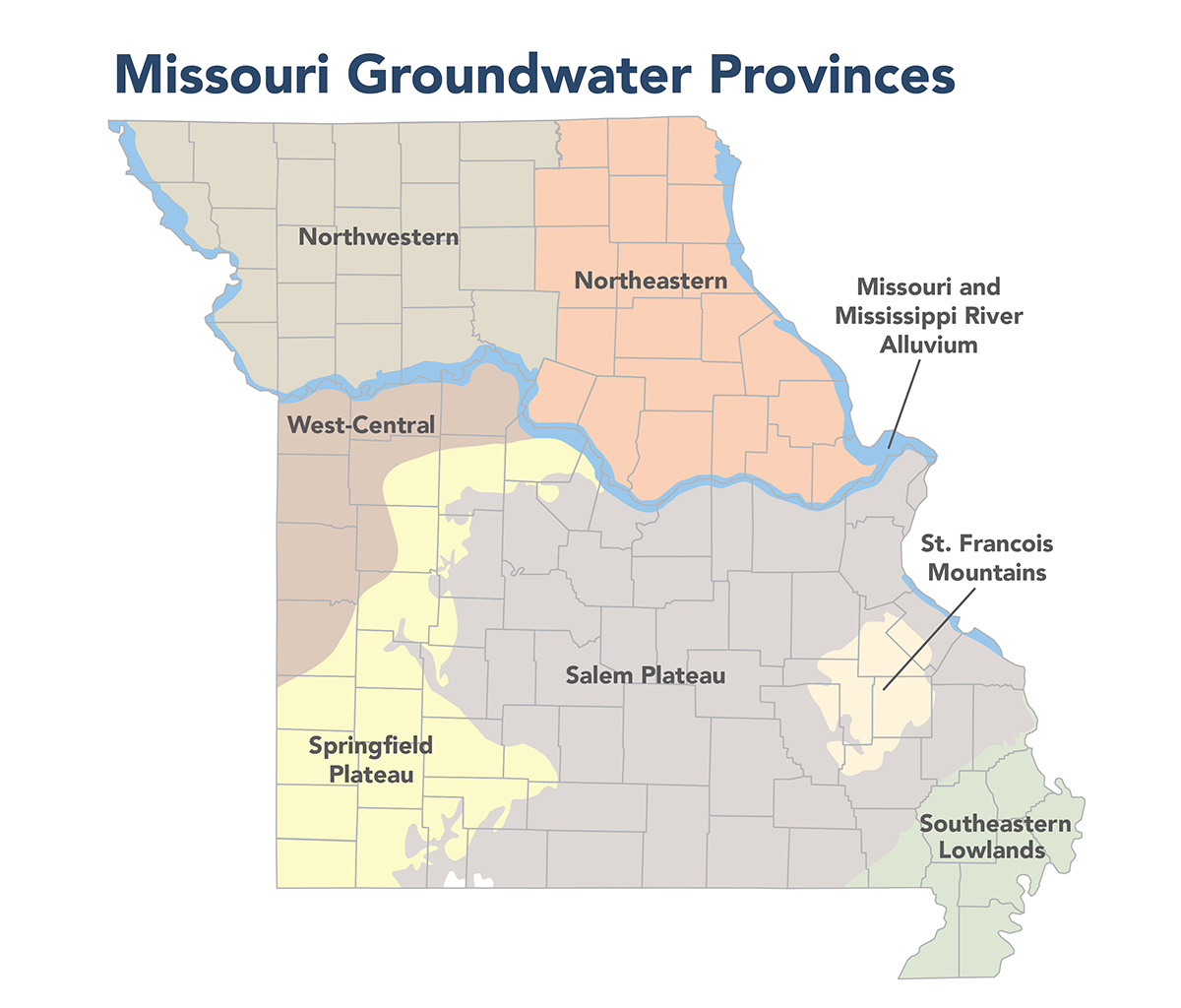
There are more than a dozen major aquifers underlying various parts of the state. In some areas, three or more aquifers are present. In other areas where groundwater resources are poor, there may only be one aquifer or none at all. Because of these differences in geologic conditions, Missouri is divided into eight major groundwater provinces:
- Mississippi and Missouri River Alluvium Groundwater Province - PUB2997
- Northeast Missouri Groundwater Province - PUB2998
- Northwest Missouri Groundwater Province - PUB2999
- St. Francois Mountains Groundwater Province - PUB3003
- Salem Plateau Groundwater Province - PUB3000
- Southeastern Lowlands Groundwater Province - PUB3001
- Springfield Plateau Groundwater Province - PUB3002
- West-Central Missouri Groundwater Province - PUB3004
The groundwater province boundaries do not represent groundwater divides. The boundaries are drawn based on several factors, including aquifer characteristics, groundwater quality changes and aquifer boundaries. Aquifers, and consequently local and regional groundwater flows, can and do cross the various groundwater provinces.
Groundwater Availability
Much of Missouri contains an abundance of fresh, drinkable groundwater available for use. However, groundwater sources in Missouri are not evenly distribute. Missouri's groundwater sources vary greatly across the state — tied closely to the geology of the various regions. The largest, most extensive aquifer is the Ozark Aquifer in the Salem and Springfield Plateau groundwater provinces, covering most of the southern half of Missouri. The amount of usable groundwater is far less in northern Missouri, where only about 12% of Missouri's potable groundwater is found.
Groundwater Quality
Water termed “fresh” or “potable” refers to water containing less than 1,000 milligrams per liter (mg/L) of total dissolved solids, and less than 250 mg/L each of sulfate and chloride. These criteria are based, in part, on secondary water-quality standards used by the department for public water supplies. Missouri’s aquifers are estimated to contain as much as 500 trillion gallons of potable groundwater that needs little or no treatment before it is safe for use.
In Missouri a natural feature known as the freshwater-saline water transition zone runs from approximately Joplin to Warrensburg, to Mexico to Troy to Festus. Groundwater contained in deeper aquifer zones south of the transition zone generally contains less than 1,000 mg/L total dissolved solids, and less than 250 mg/L of chloride and sulfate. This groundwater is generally potable without treatment. North of the transition zone, groundwater in the same aquifer zones becomes increasingly mineralized. This groundwater contains excessive total dissolved solids and chloride, and may contain excessive sulfate which makes the water unpotable. Thus, the total volume of groundwater in storage statewide is somewhat greater than the volume of freshwater available to Missourians.
Groundwater Yield
Nearly all geologic formations in Missouri are capable of storing and discharging varying amounts of groundwater. However, not all of the units yield water in sufficient amounts to be considered important aquifers. The distinction between an important aquifer and one which is not is often subjective, and to a great extent depends on location and perspective. A rural resident living in northwestern Missouri might be pleased to have a well that yields one to three gallons per minute (gpm). Since groundwater resources are generally poor in this area, and yields greater than this are uncommon, such a yield would be considered good by local standards. Another person living in central Missouri, where well yields are generally better, would likely be disappointed if his well yielded less than 15 gpm. For an irrigation system, public water supply, or an industry requiring substantial water, any quantity less than several hundred gallons per minute may not be considered significant.
Studies and Projects
Studies
- Missouri Water Resources Plan - Outlines a comprehensive strategy to increase the understanding of Missouri’s water resource needs. By identifying future shortfalls in water supplies and exploring options to address those water needs, the plan will help ensure that Missouri’s water resources will meet future demands.
- Missouri Water Supply Studies - Water availability studies used to ensure communities and department managers have the information needed to determine and allocate existing water supplies.
Ongoing Projects
- Groundwater Level Monitoring - The department has been monitoring changes in groundwater levels throughout Missouri since the mid-1950s.
- Major Water Users - Monitoring the health of our water sources by calculating water demand using data provided by Missouri's major water users.
- Missouri Water Tracing Laboratory - The department uses non-toxic fluorescent tracer dye to track the path, speed and destination of water moving between surface water and underground aquifers.
- Northeast Missouri Aquifer Characterization Project - The department is investigating possible groundwater resources in shallow buried channel aquifers in nine counties in northeast Missouri. The goal is to find sources of potable groundwater to assist landowners in locating favorable water well construction sites, which may provide solutions to negative drought impacts on the region’s water supply.
- Soil Moisture Monitoring and Mapping Initiative - The department is currently conducting soil monitoring in 22 counties throughout Missouri. The amount of moisture in soil helps us understand the potential for water storage and movement within the soil.
- Statewide Missouri Natural Resource Damage Assessment and Restoration (NRDAR) - Projects to restore, protect and preserve the state’s groundwater resources in the Kansas City metropolitan and Springfield areas.