
Missouri’s energy landscape is always evolving, and the state’s policies need to adapt to these changes. Missouri Revised Statutes section 620.035, RSMo, tasks the Missouri Department of Natural Resources' Division of Energy with assessing the impacts of national policies, monitoring and analyzing private-sector energy projects and data and analyzing the potential for increased use of a variety of energy resources.
The department's Division of Energy convenes governmental, industry and community stakeholders to plan for energy’s role in Missouri’s economic future. The State Energy Program works to ensure that local and state decisionmakers have timely and accurate analysis and that Missouri’s energy priorities are sufficiently incorporated into the national energy discourse.
Recently the State Energy Program led the development of a new State Energy Plan. The department partnered with the Environmental Improvement and Energy Resources Authority (EIERA) to secure a contractor to perform quantitative modeling and analysis of Missouri's current and projected energy resource needs. Below is the resulting State Energy Plan, released Sept. 30, 2026.
Energy Priorities
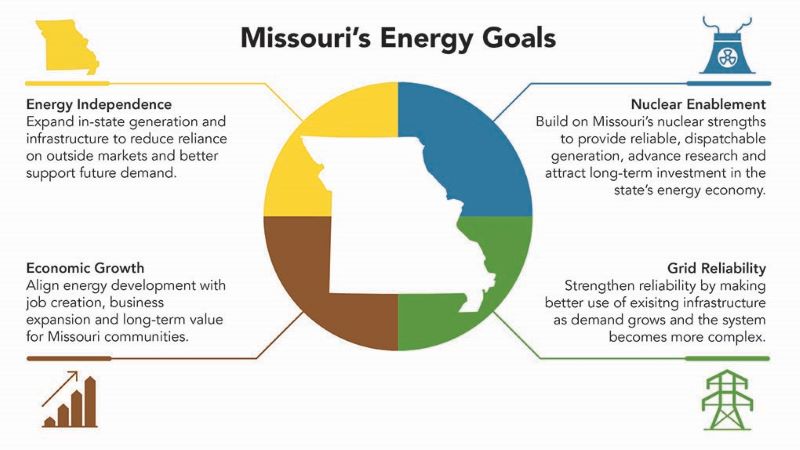
The 2026 State Energy Plan is built upon four pillars:
- Energy Independence. Over the past decade, Missouri shifted from being a net exporter of electricity to a net importer. Moreover, virtually all of the fuel used to supply Missouri power plants comes from outside the state. As a result, an increasing share of Missourians’ electricity bills pay to support jobs, taxes and economic development in other states. The energy plan prioritizes more in-state generation to reverse the outward flow of economic investment, attract billions of dollars in new industrial opportunities and recover thousands of direct and indirect jobs.
- Nuclear Enablement. Missouri’s baseload and dispatchable power has been shutting down due to market forces and federal regulations. This trend conflicts with unprecedented near-term electricity demand growth. Nuclear power is the only carbon-free baseload electricity option that can diversify the state’s energy portfolio to avoid overreliance on any one fuel.
- Economic Growth. Relying on out-of-state generation results in lost economic opportunities and increases price-related risks. Building new in-state generation supports economic growth, jobs and new tax revenue opportunities. These benefits are even greater when considering investments in nuclear power.
- Grid Reliability. Maintaining reliable power is becoming a greater challenge as legacy baseload and dispatchable power plants retire. The State Energy Plan’s policy recommendations are designed to support increased investment in reliable power sources, as well as to bolster the grid through customer-oriented solutions.
Methodology
The State Energy Plan is a policy impact assessment, as opposed to the integrated resource plans (IRPs) filed by many utilities. A utility IRP focuses on short-term investment decisions guided by the most likely outcomes for a single electric utility. By contrast, the State Energy Plan uses a broader range of input assumptions to evaluate the outcomes of policy decisions. The modeling illustrates tradeoffs across scenarios and highlights how choices around resource diversity, in-state generation and voluntary energy efficiency influence long-term system performance and risk. Evaluating these tradeoffs informs policy decisions rather than predicts future resource deployment.
The State Energy Plan includes power sector modeling that projects investments in new power plants based on economics and reliability needs. The modeling begins with a “business-as-usual” baseline scenario, then branches into additional scenarios based on potential policies related to in-state generation, nuclear enablement, intermittent generation, and voluntary energy efficiency programs. Each of these scenarios enables the assessment of the pros and cons of different policies. Economic modeling builds on the power sector model results to identify potential impacts to economic value added, jobs supported, personal income, and taxes. A value of distributed resources study provides methods and sample analyses related to the costs and benefits of customer-sited resources, including residential solar and battery storage, commercial solar, and large loads with battery storage.
Recommendations
The modeling results support the following high-level policy-related recommendations:
- Support in-state investment to increase local economic development benefits.
- Pursue policies that reduce the capital cost and development risk of nuclear power so that diversification and emissions benefits become available on economic terms.
- Actively encourage a diversified resource portfolio rather than concentrating on a single fuel.
- Continue voluntary energy efficiency program investments.
- Pair large loads with customer-side measures to facilitate economic development and support downward pressure on rates.
- Use multiple cost-effectiveness tests to systematically evaluate distributed energy resources.
Next Steps
Missouri's Focus
The department was tasked by the governor to curate the Advanced Nuclear Energy Task Force. Established by Executive Order 26-04, the task force is charged with implementing many of the policy recommendations in the State Energy Plan.
The department also will continue to advise and engage with local, state and federal partners to proactively represent and advance Missouri’s energy goals.
National Focus
The nation’s focus is on “a reliable, diversified, and affordable supply of energy to drive manufacturing, transportation, agriculture, and defense industries, and to sustain the basics of modern life and military preparedness.” The President’s Executive Orders set a new direction for policy at the national and state levels.
Previous Plans
Efforts around a comprehensive examination of Missouri's energy challenges and planning have been ongoing since the 1990s. These efforts have included determining Missouri’s contribution to global climate change and ozone depletion, conducting a statewide energy study, evaluating energy security post-9/11, convening a task force focused on renewable fuels and affordable heating bills, and contemplating Missouri’s energy future. The comprehensive plans listed below were developed to put Missouri on the path to meet its short- and long-term needs for clean, reliable, affordable and abundant energy.
Comprehensive State Energy Plan (CSEP) - 2015
Missouri’s Comprehensive State Energy Plan (CSEP) was an effort to develop an energy plan that balanced the need for low-cost, reliable energy with our duty to be responsible stewards of the environment. The CSEP included recommendations to promote efficiency of use, ensure affordability, diversify and promote security in supply, undertake regulatory improvements and stimulate innovation, emerging technologies and job creation. The final version of the CSEP reflected the regulatory environment of its time.
Missouri State Energy Planning (MoSEP) - 2020-2023
From 2020-2023, the department engaged in a Missouri State Energy Planning (MoSEP) process to meet changes in the energy sector and further the governor’s infrastructure, workforce development and government efficiency priorities. The MoSEP process identified topics critical to Missouri’s energy needs through stakeholder engagement. The department brought together stakeholders to address emerging issues and embarked on a two-year process to consider select topics in-depth.
Contact Information
Division of Energy
1101 Riverside Drive
P.O. Box 176
Jefferson City, MO 65102-0176
United States