
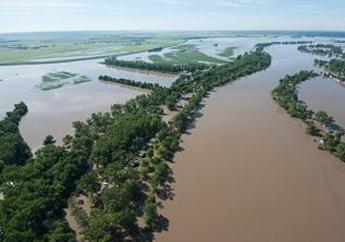
Water level of a river rose over the tops of its banks, into the surrounding fields

Application Period is Open

The Flood Resiliency Improvement Fund (FRIF), established by the Flood Resiliency Act in 2023 (Section 256.800, RSMo), provides financial assistance for projects that 1) increase flood resiliency along the Missouri and Mississippi rivers and their tributaries or 2) improve statewide flood forecasting and monitoring ability.

The statute allows the Flood Resiliency Program, administered by the Missouri Department of Natural Resources’ Water Resources Center, to work with a promoter and their partners in the development, construction or renovation of a flood resiliency project; or the state may promote a flood resiliency project and initiate a plan on its own.

Flood resiliency projects include planning, design, construction or renovation of flood resiliency measures or the conduct of studies or activities in support of flood resiliency measures. Flood resiliency measures include structural improvements, studies and activities employed to improve flood resiliency in local to regional or multijurisdictional areas.

Flood resiliency is the ability to anticipate, prepare for, and adapt to changing water hazards, including changing river flow and stage conditions, heavy precipitation, inland flooding, and flash floods, and to withstand, respond to, and recover rapidly from flood disruptions. Four main principles of resiliency are preparing for flood events and their aftermath, absorbing the impacts of flooding with minimal damage, recovering to pre-flood conditions and functionality, and adapting to changing conditions and lessons learned.

Information and Assistance

For additional information, please contact the Water Resources Center’s Fund Coordinator at 573-522-1166 or the Water Resources Center directly by phone at 573-751-2867 or by email at mowaters@dnr.mo.gov

Who Can Apply

FRIF eligibility is limited to promoters, defined as “any political subdivision of the state, or any levee district or drainage district organized or incorporated in the state”, and their partners, defined as “a political subdivision, entity, or person working in conjunction with a promoter to facilitate the completion of a flood resiliency project.”

Eligible Projects and Costs

Flood resiliency can take many different forms and can be achieved in many different ways depending on community needs, resource availability and willingness to do a project. The costs vary widely depending on the scope and complexity of the project.

The first step in improving flood resiliency is to study the issue to understand the potential magnitude and duration of impacts of various flood scenarios to identify and articulate the need, develop and analyze alternative solutions to achieve desired goals while balancing need and cost, and develop engineering designs to implement the project.

Flood resiliency measures include but are not limited to a wide range of structural measures like armoring weak points on levees, levee conveyance setbacks, road raises, controlled backfill locations on levees, land acquisition in developed recurring flood prone areas, wet/dry floodproofing, replacement of undersized culverts, and drainage structure replacements. Flood resiliency also includes non-structural activities like developing Emergency Action Plans and other logistical and resource management plans.

Finally, flood resiliency can come from our ability to monitor and forecast flooding. In some circumstances, adding a new stream gage to the Missouri stream gage network could be a solution.

In short, flood resiliency projects need to identify a long-term flood mitigation need and develop a plan that provides long-term flood resiliency.

Award Amounts and Match

Funding is only available in the FRIF when appropriated by the Missouri legislature. The FRIF does not currently have an annual appropriation or significant cash balance, but applications to it can help demonstrate the need for future appropriations. Appropriations are subject to the discretion of the Missouri legislature based on their annual budget priorities and needs and, therefore, even an approved plan is not a guarantee of funding.

The costs, and therefore award amounts, vary widely depending on the scope and complexity of the project. Currently there is no funding minimum or maximum and there is no statutory match requirement. However, the cost and benefits of proposals will be considered. Because of the current nature of how the FRIF operates, alternatives that have the highest return on investment while achieving long-term flood resiliency will increase the likelihood of being approved and funds appropriated.

Application Process

To apply for the FRIF, a sponsor must submit a plan for approval describing the need for, and implementation of, flood resiliency measures. The plan shall include a description of the flood resiliency project, the need for the project, the flood resiliency measures to be implemented, the partners to be involved in the project, and other such information needed to adequately evaluate the merit of the project. A plan will only be approved upon a determination that long-term flood mitigation is needed in that area of the state and that such a plan proposes flood resiliency measures that will provide long-term flood resiliency.

Because flood resiliency projects are unique and complexity varies depending on the need, please contact the Water Resources Center’s Fund Coordinator prior to developing or submitting applications.

Applications should be submitted to the Water Resources Center email at mowaters@dnr.mo.gov.

Resources