
Missouri's climate is characterized by hot, humid summers, cold winters and variable seasonal rainfall. During summer months, warmer temperatures speed up water loss through soil evaporation and plant transpiration. The combination of heat and infrequent rainfall can lead to drought conditions such as declining water levels in lakes, reservoirs and aquifers, declining stream and river flows, brittle and dry vegetation and decreasing crop yields. Drought can have a serious impacts on health, agriculture, economies, energy and the environment.
Nearly every year, parts of Missouri have short periods of drought. Severe droughts have been experienced multiple times in Missouri's history, most recently in 2012 and 2018. Some impacts associated with drought can be mitigated, or lessened, by proactively planning actions that can be taken before water shortages occur. Actions can also be taken during and after a drought to help recover from its impacts on people, the environment and the economy. After more than two years of study and development, the Missouri Department of Natural Resources replaced Missouri's 2002 Drought Plan with an enhanced Missouri Drought Mitigation and Response Plan.
2023 Missouri Drought Mitigation and Response Plan
The 2023 Missouri Drought Mitigation and Response Plan uses modern tools for enhanced monitoring and assessment of all types of droughts. It also gives guidance to government officials, water users, water suppliers and industry leaders for adopting water conservation best practices to grow their drought resiliency. The main goals of the Missouri Drought Mitigation and Response Plan are serving as an information source for reducing drought impacts, increasing public awareness, enhancing resiliency, promoting water conservation, improving monitoring, facilitating response planning, as well as clarifying roles and responsibilities.
A key component of the Missouri Drought Mitigation and Response Plan is a matrix of over 100 drought mitigation actions and strategies. The matrix is intended to help state, federal and local government officials; commercial, industrial and private water users; and public and private water suppliers in both planning for and responding to drought events in Missouri. Some of the actions and strategies presented in the matrix have already been implemented and proven to be useful in mitigating impacts.
Drought Response Phases
As described in the plan, Missouri’s Drought Response System has been divided into five phases to provide for a measured response to worsening effects of drought, typically on a county-by-county basis. This drought monitoring and assessment system provides for state and local planners to proactively coordinate and take action to raise awareness and mitigate the effects of drought. The five phases, which guide state-level government actions and responsibilities, include:
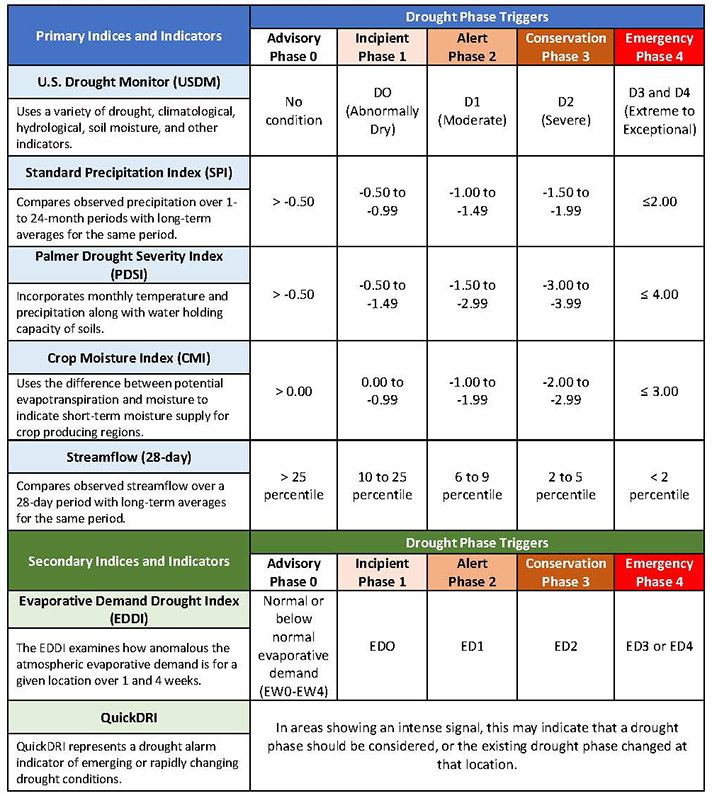
- Phase 0 - Advisory Phase: The department's Water Resources Center, in consultation with the state climatologist, conducts weekly reviews of the drought indices and indicators, and other climate conditions and forecasts. The advisory phase continues if indices and indicators show no evidence of emerging drought conditions.
- Phase 1 - Incipient Phase: When climate forecasts and primary indices and indicators signal that dry conditions are possible in the coming months, the department's Water Resources Center activates the Climate and Weather Committee (CWC) and notifies the department director that worsening conditions may warrant activating the Drought Assessment Committee. Emerging or rapidly changing conditions, the secondary indices and indicators, can also trigger this phase. Incipient phase conditions correlate to the U.S. Drought Monitor's D0 category, which represents abnormally dry conditions.
- Phase 2 - Alert Phase: The alert phase is declared when the CWC identifies worsening but still moderate drought conditions. These conditions correlate to the U.S. Drought Monitor's D1 category representing moderate drought. The department department director requests the governor of Missouri make a drought declaration for the counties or regions of the state experiencing alert phase drought conditions. The drought alert declaration directs state agencies to work together in providing as many resources and as much assistance as possible to impacted communities. The Drought Assessment Committee is activated and consists of representatives from state and federal agencies. The committee is supported by input from stakeholders representing impacted counties or regions. Impact teams of technical experts may be formed to help gather and review data.
- Phase 3 - Conservation Phase: The conservation phase is declared when the CWC identifies worsening drought conditions and forecasts indicate an extended period of below-normal precipitation, suggesting actions to conserve water are warranted. These conditions correlate to the U.S. Drought Monitor's D2 category representing severe drought. The department director requests the governor make a drought declaration for the counties or regions of the state experiencing conservation phase drought conditions. The Drought Assessment Committee authorizes the impact teams to encourage impacted areas to implement water conservation and other plan-recommended actions and strategies to reduce water demand and conserve supplies.
- Phase 4 - Drought Emergency: The emergency phase is declared when the drought conditions enter the U.S. Drought Monitor's D3 (extreme) and D4 (exceptional) categories and forecasts indicate continued below-normal precipitation. These conditions suggest emergency actions are necessary to support essential water uses and protect public health. The department director may request the governor make a drought declaration for the counties or regions of the state experiencing emergency phase conditions. The governor activates the Drought Executive Committee independently, or at the Drought Assessment Committee's recommendation. The Missouri Department of Agriculture may draft an executive order for an agricultural disaster declaration. The Missouri Emergency Management Association may draft a Health and Public Safety Declaration.