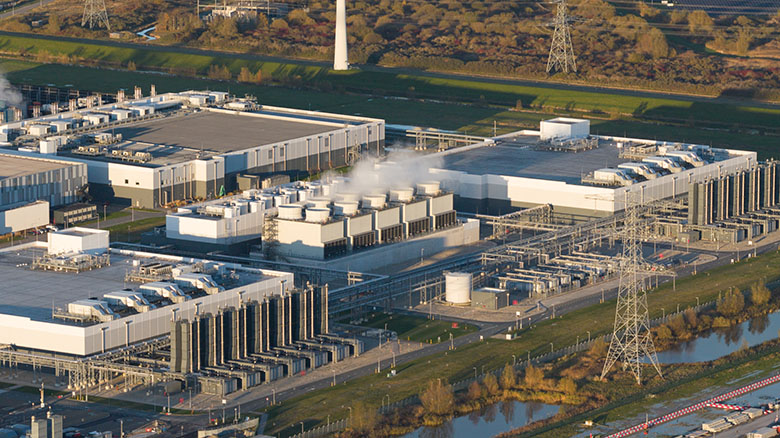
The Governor's executive order directs the department to coordinate with other Missouri state government agencies to better understand the demands for developing data centers in Missouri and to ensure that Missouri’s natural resources are effectively managed. The department is coordinating with the Missouri Department of Conservation and the Missouri Department of Economic Development. The department will deliver a report of its findings and recommendations to the Governor’s Office by Nov. 30, 2026.
Air Permits
Data centers may require backup diesel generators for their operations or may produce their own energy on site, which may result in air emissions. Before construction, the facility may need to apply for an air permit with the department’s Air Pollution Control Program (APCP), depending on the data center’s needs. After evaluating the application, the department's APCP would determine which type of permit is needed, based on the facility’s potential to emit.
- A construction permit is required before beginning construction for facilities whose potential air emissions exceed regulatory de minimis levels found in Code of State Regulations 10 CSR 10-6.020(3).
- An Air Quality Analysis is required for any pollutant that exceeds its regulatory de minimis level.
- An operating permit is required after a facility has begun operating if the potential emissions contain certain pollutant levels (tons per year).
For more information, please review the department's Air Permits webpage.
The executive order directs the department to coordinate the review of current state regulations and utility practices to ensure that constructing and operating data centers and other large power users do not result in higher energy rates for residential and small business Missourians. The department was also directed to review and project the current and future energy needs of the state, including AI infrastructure impact and developing a sustainable energy strategy. The department is currently working on the following tasks:
- The department is actively coordinating with the Missouri Public Service Commission to review current regulations and practices and will issue its findings in a report delivered to the Governor’s Office by Nov. 30, 2026.
- The department is currently developing a State Energy Plan, which will review and project the state’s current and future energy needs. The State Energy Plan is due to be completed by Sept. 1, 2026, and available to the public Sept. 30, 2026.
Energy Needs
Data center growth is expected to be the main driver impacting future energy demand in Missouri, but how big that impact will be remains uncertain. This uncertainty underlines the importance of the new State Energy Plan. Among other things, the State Energy Plan will forecast data center demand under multiple modeled scenarios to reflect the range of plausible outcomes.
Ratepayer Protection
Getting a more accurate understanding of the anticipated and projected load growth at a statewide scale will better equip all decisionmakers when evaluating decisions that may affect ratepayers and local communities. The legislature recently passed Missouri Revised Statute section 393.130.7, RSMo, which aims at protecting ratepayers from increased rates due to data center energy consumption.
The Governor's executive order directs the department to coordinate with other Missouri state government agencies to better understand the demands for developing data centers in Missouri and to ensure that Missouri’s natural resources are effectively managed. The department is coordinating with the Missouri Department of Conservation and the Missouri Department of Economic Development. The department will deliver a report of its findings and recommendations to the Governor’s Office by Nov. 30, 2026.
Water Use
Missouri is a riparian rights state, meaning all landowners touching or lying above water sources have a right to a reasonable use of those water resources. Missouri state law does not restrict water use, provided the use is reasonable and the use is within the state of Missouri. Citizens with riparian rights may protect those rights from unreasonable use through private legal action that does not involve the department. For more information about water rights, please refer to A Summary of Missouri Water Laws. Among other information, details on rights to groundwater can be found from page 15 onward and riparian rights from page 27 onward.
There are no regulatory restrictions on the amount of water that can be used or for what purposes. Consequently, while the department regulates water quality, it does not regulate water amount or usage, beyond exporting water out of state and requiring annual reports of major water users. A major water users is any facility or individual with the capability to withdraw at least 100,000 gallons per day (70 gallons per minute) from any water source in Missouri, including wells (groundwater) or surface intakes (streams, rivers, lakes, springs, etc.). Missouri state law requires major water users to register with the department and report their yearly water usage to the department each January, for the water used the year before. The department uses the reports to understand the state’s water needs. For more information, please visit Major Water Users.
Water Quality
Water quality is a measure of the chemical, physical and biological characteristics of water, usually in relation to its suitability for a specific use, such as drinking, swimming or supporting aquatic ecosystems. The department brings together and coordinates all aspects of water quality in an effort to ensure the state’s progress toward protecting, preserving and improving water quality in Missouri.
- Before a facility is built, a land disturbance permit is required if one or more acres of land will be disturbed.
- Water discharge permits ensure that water quality standards are met for any project that discharges into a body of water. With discharge permits there are also monitoring and reporting requirements, as well as an expected inspection frequency.
- The department has enforcement authority if water quality violations occur.
For more information about water quality and usage, please visit How's the Water. For additional business-related water information, please visit Water - Business, Industry and Other Entities.
Any equipment or products used that qualify as hazardous waste will be covered under Missouri Hazardous Waste Management Law, sections 260.350 to 260.433, RSMo.
- Companies that actively treat, store (for more than 90 days) or dispose of hazardous waste are required to get a hazardous waste permit.
- Companies producing hazardous waste (generators) generally do not need a hazardous waste permit if they store it for less than 90 days and do not treat it.
- Permits are normally effective for a 10-year period.
For more information, please visit Hazardous Waste Permits, Licenses and Registrations.
Section 106 of the National Historic Preservation Act requires federal agencies to take into account the effects of their undertakings on historic properties and to assess potential impacts on architectural and archaeological resources. The federal agency involved in a project makes a Section 106 determination of effect, which is a finding that establishes if a project impacts architectural or archaeological resources. Missouri’s State Historic Preservation Office, which is part of the Missouri Department of Natural Resources, is responsible for reviewing the federal agency’s determinations of effect, but does not review projects that do not have federal involvement.
- If a data center proposal is receiving federal funding, licensing or permitting, it is considered a federal undertaking.
- Absent federal funding, licensing or permitting, data centers do not trigger a state review process similar to a Section 106 review.
For more information, please visit Section 106 Review.
Noise, Light, Sound and Zoning
The department does not regulate noise, light or sound. Noise, light and sound are usually regulated at the local level. The Department of Natural Resources is not involved in local planning and zoning.
Fish, Forest and Wildlife
Please refer to the Missouri Department of Conservation (MDC) for questions related to fish, forest and wildlife concerns. You may also visit MDC’s Data Centers in Missouri webpage.
Public input is essential to our permitting process. We encourage Missouri citizens to sign up to receive the department’s Get Email Updates notifications so that they may be made aware of any upcoming projects/permits. The department also provides online, public notices that have been issued for currently open public comment periods and scheduled public meetings and public hearings. This list may include draft or proposed permits, rulemaking, state actions, plans, bond issues, tax proposals, public improvement projects and more. This list is available on the department's Public Notices/ Public Comments webpage.
Questions?
| Topic | Specific Issue | Contact |
|---|
| Air | - Air monitoring
- Air permitting
- Diesel generators
| Missouri Department of Natural Resources
Air Pollution Control Program
573-751-4817 |
| Water use | - Water use
- Water exporting
- Water sources
- Well drilling
| Missouri Department of Natural Resources
Water Resources Center
573-751-2867 Missouri Department of Natural Resources
Well Installation Section
573-368-2165 |
| Water quality | - Land disturbance
- Water quality
- Discharges
- Drinking water systems
| Missouri Department of Natural Resources
Water Protection Program
573-751-6721 |
| Waste | - Hazardous waste
- Solid waste
| Missouri Department of Natural Resources
Waste Management Program
573-526-3900 |
| Energy | - Energy use
- Impacts to grid
| Missouri Department of Natural Resources
Division of Energy
573-751-2254 |
| Noise, light, sound and zoning | The department does not regulate these. | Please contact your local city or county officials. |
| Fish, forest and wildlife | The department does not regulate these. | Missouri Department of Conservation
573-522-4115 |
| Communications | | Missouri Department of Natural Resources
Office of Communications
573-751-1010 |