

Ozone, or O3, is a gas composed of three atoms of oxygen in each molecule. Ozone in the upper atmosphere, or stratospheric ozone, occurs naturally and forms a protective layer that helps to shield us from the sun's harmful ultraviolet rays. Ozone near ground level, or tropospheric ozone, is a harmful air pollutant, and it is one of the main ingredients in photochemical smog.
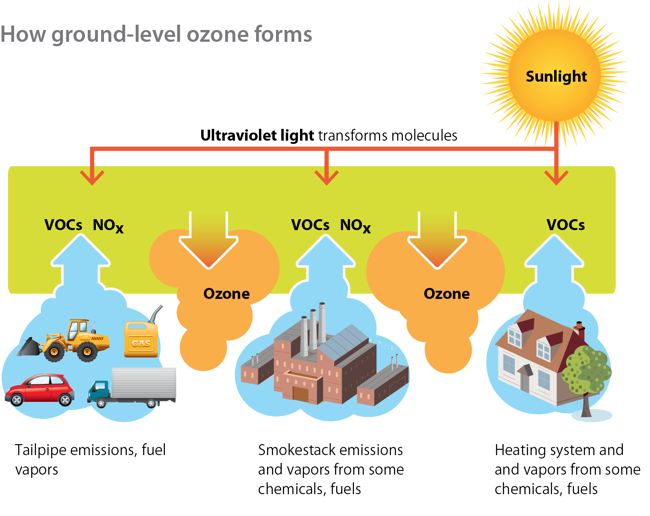
Ground level ozone is not emitted directly into the air, but is created by chemical reactions involving nitrogen oxides, volatile organic compounds and oxygen. The energy for the reactions is provided by sunlight. The precursor pollutants that enter these reactions are emitted by cars, power plants, industrial boilers, refineries, chemical plants and other sources. The picture illustrates some of these sources and the complex reactions that form photochemical smog, including ground level ozone. More information is available on EPA's Ground-level Ozone Pollution webpage.
Missouri monitors ozone concentrations in the air at several locations across the state. Most of these monitoring sites are operated during March through October, because ozone formation in the air is more likely in the summer months. Click on the Air Monitoring Sites tab to learn more about these sites. Click on the Monitoring Data tab to learn more about the data collected from this sites.
For information about other ambient air pollutants that the department monitors, visit Air Pollutants and Sources.
Contact Information
Air Pollution Control Program
Division of Environmental Quality
P.O. Box 176
Jefferson City, MO 65102-0176
United States