
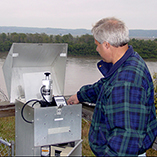
The Missouri Department of Natural Resources implements the requirements of the federal Clean Air Act, which sets standards called National Ambient Air Quality Standards (NAAQS). These standards are established by EPA to protect human health effects and are available in the NAAQS Table. The department monitors the ambient air for the six criteria pollutants: carbon monoxide, lead, nitrogen dioxide, ozone, particulate matter and sulfur dioxide. Weekly, monthly or quarterly air monitoring data is available within the pollutants web pages below.
Other air pollutants, called hazardous air pollutants, are address by section 112 of the Clean Air Act. Although they are found in the ambient air, there are no federal ambient air quality standards set to address these pollutants. Instead, federal rules are established to place emissions standards, or requirements, on sources of hazardous air pollutants called new source performance standards. These standards place national emission standards for hazardous air pollutants for categories of sources that emit hazardous air pollutants to the air.




Contact Information
Air Pollution Control Program
Division of Environmental Quality
P.O. Box 176
Jefferson City, MO 65102-0176
United States