
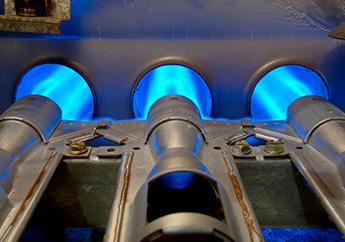
Natural gas is a fossil fuel that forms through the decomposition of ancient marine microorganisms. These microorganisms, such as algae and plankton, settle to the bottom of the water column and mix with other particles and sediments. Over time, deposits like this may get buried under successively younger layers of sediment and become compacted, exposing them to increased pressure and heat. Under these settings, the organic-rich components are unable to escape. Gas produced from decomposition is trapped within the sedimentary rock.
Natural gas plays a critical role in the energy sector because it serves as a versatile fuel for heating, producing electricity and transportation. It is the main fuel source for U.S. electricity production, accounting for approximately 43% of the nation’s electricity generation. Natural gas is also the most common residential heating fuel, serving as the main heating source for 47% of U.S. households in 2024.
Natural Gas in Missouri
In Missouri, natural gas is an essential energy source for both electricity production and residential heating. Although coal currently produces almost 57% of Missouri’s electricity, natural gas-fired generation has been steadily increasing. Gas production numbers have been collected by the department’s Missouri Geological Survey since 1928. Currently, natural gas supplies about 15% of the state’s total electricity generation.