
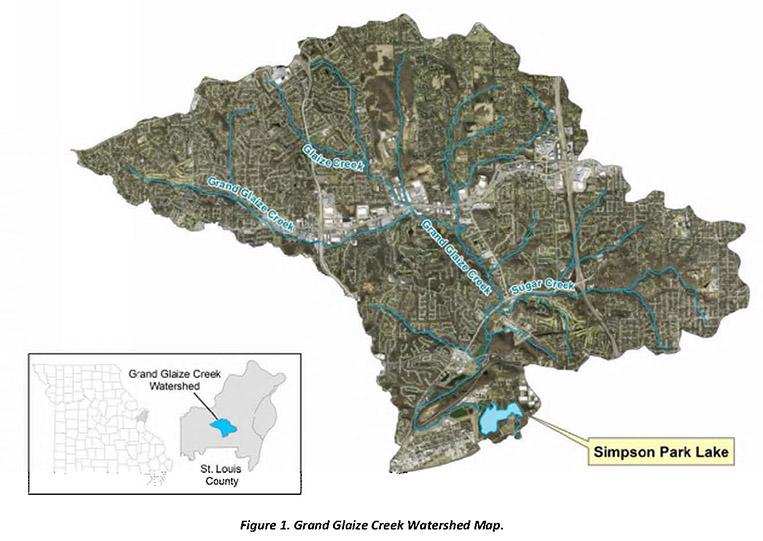
The Grand Glaize Creek watershed drains approximately 23.9 square miles within St. Louis County, Missouri. The watershed is a predominantly urban residential watershed that includes parts of Kirkwood, Des Peres, Town and Country, Ballwin, Manchester and Valley Park. The Grand Glaize Creek 12-digit Hydrologic Unit Code (HUC12) subwatershed (HUC #071401021002) is located within the the Meramec River basin.
The main waterbodies within the Grand Glaize Creek watershed include Grand Glaize Creek and Simpson Park Lake. Grand Glaize Creek is a class C, urban stream. Simpson Park Lake is a 64-acre lake created in 1955. A dam was built to impound water from Grand Glaze Creek, allowing Simpson Sand and Gravel to float a barge for dredging sand and gravel. Dredging continued until the 1970s, when the park was purchased by St. Louis County. In 1993, the Missouri Department of Conservation agreed to manage the fish in Simpson Park Lake, which currently supports at least 39 different fish species.
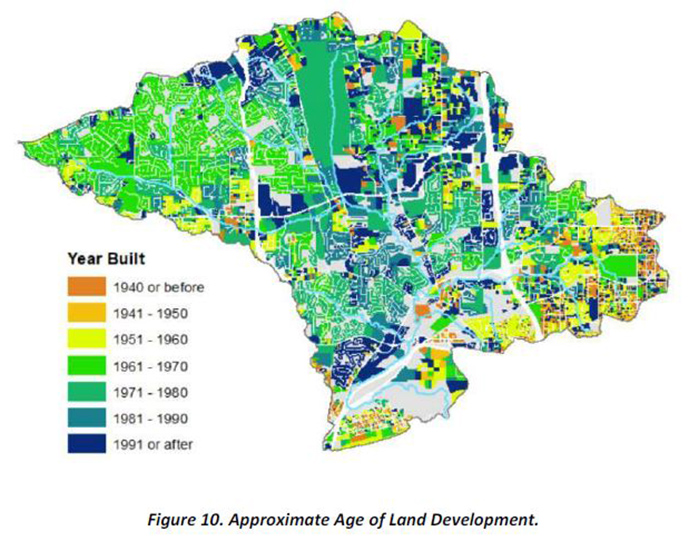
The Grand Glaize Creek watershed is predominantly an urban environment: developed (79.3%), deciduous forest (18.6%) and woody wetlands, grasslands, shrubs, mixed and evergreen forests (less than 2%). The total imperviousness of the watershed is estimated at approximately 31%. Large areas of imperviousness lead to greater urban and stormwater runoff. Karst features, which are vulnerable to water quality degradation, are also common in this area. There are 10 sinkholes located in the Grand Glaize Creek watershed.
Water Quality Issues
Grand Glaize Creek and Simpson Park Lake are included on the state’s 303(d) list of impaired waters. In 2006, the Missouri Department of Natural Resources (MoDNR) listed Grand Glaize Creek, which drains into Simpson Park Lake, as impaired due to excess chloride, and in 2008, due to E. coli. In 2020, the U.S. Environmental Protection Agency (EPA) listed Simpson Park Lake as impaired due to excess nutrients (Chlorophyll-a). MoDNR considers urban runoff and nonpoint source pollution as the cause of impairment.
Pollutant sources in the Grand Glaize Creek watershed are typical of urban environments, including damaged sanitary sewer systems, stormwater runoff and streambank erosion. In 2016, the Metropolitan St. Louis Sewer District (MSD) eliminated all constructed sanitary sewer overflows from the Grand Glaize Creek watershed, in accordance with its Consent Decree. E. coli levels have improved since this time, but failing septic systems and damaged private sewers continue to be a source of pollution. Stormwater runoff from pet waste, fertilizer and yard waste, and wildlife also represent a significant source of pollutant loading. Internal loading from Simpson Park Lake also represents a significant source of phosphorus due to decades of siltation.
Watershed Management Plan
MSD partnered with St. Louis County and other municipal co-permittees to implement a watershed-based plan in order to restore and protect the Grand Glaize Watershed. The current watershed plan for bacteria and nutrients was developed by the project partners and accepted by U.S. Environmental Protection Agency (EPA) in April 2025. This watershed plan incorporates the critical elements outlined by the EPA.
The plan initially addresses reducing E. coli and total phosphorus (TP), as TP is considered the controlling nutrient responsible for algal growth in the lake. Chloride and mercury may be addressed within future adaptations of the watershed plan.
Project Goals
The overall goal of the Grand Glaize Creek Watershed Plan is to fully restore recreational and warm water aquatic life beneficial uses in Grand Glaize Creek and Simpson Park Lake. Specific objectives to achieve this vision include:
- Reducing internal phosphorus loading at Simpson Park Lake by removing siltation that has been building-up for decades.
- Constructing a sediment forebay to minimize additional sedimentation and nutrient loading into Simpson Park Lake.
- Significantly reducing urban sources of bacteria and nutrients within the Grand Glaize Creek watershed.
Expected pollutant load reductions necessary to restore recreational and warm water aquatic life beneficial uses in Grand Glaize Creek and Simpson Park Lake were estimated based on water quality data and current water quality standards. Water quality data from Grand Glaize Creek near Valley Park indicates a 47% reduction in E. coli loading is needed to meet the recreational water quality criterion of 206 cfu/100 mL. Results of the BATHTUB model predict an instream TP target concentration of 0.079 mg/L is needed to meet the Chlorophyll-a criterion of 22 ug/L in Simpson Park Lake. The BATHTUB model does not explicitly account for internal phosphorus loading, therefore, a 31% reduction in internal loading was also considered needed.
Implementation Measures
To achieve the targeted pollutant reductions, the following management measures have been identified:
- Elimination of constructed sanitary sewer overflows as required by MSD’s Consent Decree was completed in 2016. Data indicates E. coli levels have significantly decreased since this time.
- Continued implementation of the minimum control measures in the St. Louis Metropolitan Small Municipal Separate Storm Sewer System (MS4) Phase II Stormwater Management Plan.
- Additional management measures including the following, which the project partners envision three 5-year phases for implementing:
- Phase 1: Enhanced education and outreach that goes beyond the existing MS4’s minimum control measures.
- Phase 2: Streambank stabilization projects at five locations identified in the watershed.
- Phase 3: Simpson Park Lake enhancements, including a sediment forebay and dredging to reduce internal phosphorus loading.
- All Phases: Implementing a septic and private laterals sewer coupon program. At the end of the third phase, project partners will evaluate extending the coupon program into a fourth phase based on results of the water quality assessment data.